
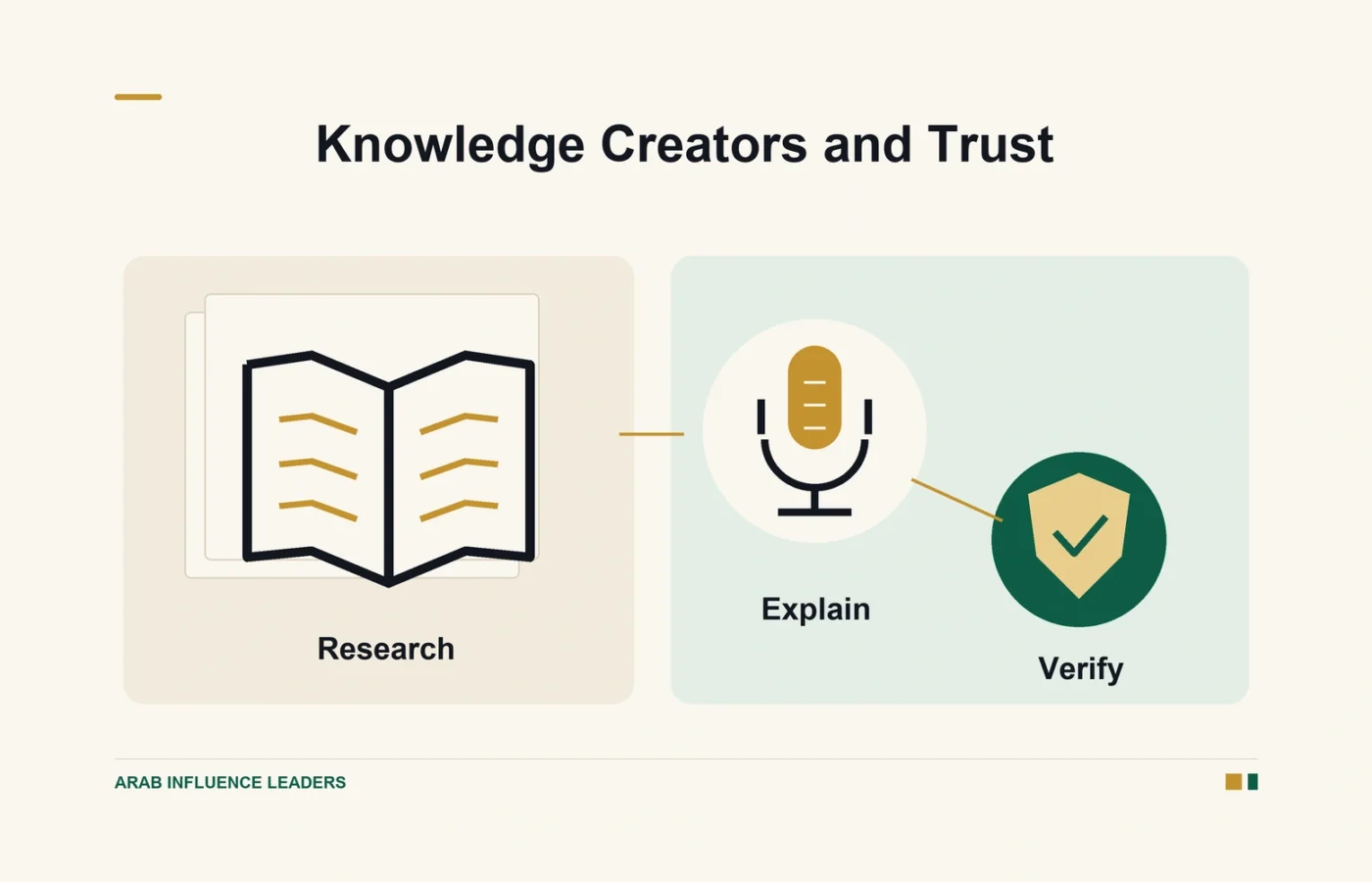
By Arab Influence Leaders. This analysis was prepared with AI assistance and draws on the sources below. Original illustration by Arab Influence Leaders.
A short video may introduce a student to a scientific idea. An illustrated story may prompt a reader to investigate the history of a building. Arab knowledge creators can offer those first points of access, then help people explore further. This analysis considers what turns an introduction into knowledge that readers can examine and use, drawing on documented examples from education, science and culture.
Start with a question worth answering
A useful knowledge project starts with a specific question: how something works, what evidence supports an idea or why researchers interpret it differently. That question helps the creator choose examples, explain unfamiliar terms and decide where simplification needs more context. It also gives readers a way to judge whether the material delivered what it promised.
Possible formats include a repeatable learning activity, a guide to reading a historical document or an explanation of a chart. These are design choices, not proof of social impact. Inspiring curiosity and teaching a skill are different achievements. A clip may succeed at the first, while the second requires practice, questions and feedback.
Connect science, culture and education
On 10 March 2023, TED published the speaker programme for its TEDinArabic Summit, organised with Qatar Foundation. It included Lebanese physicist and poet Mahdi Mansour discussing science and creativity, Jordanian roboticist Lama Sha’sha’a addressing robotics in education, and Lebanese preservation activist Mona Al Hallaq exploring the protection of historic buildings. The programme documents these speakers and subjects; it is not a ranking of influencers.
For an editor, that range suggests several ways into a subject. A story about a historic building could combine photographs, a map and archival material while distinguishing documented details from interpretation. An educational presentation could demonstrate an activity and explain its limits. In both cases, the content becomes more useful when readers can see how the explanation was assembled.
Give learners a clear next step
In an announcement published on 27 January 2026 about its 2025 impact report, Edraak reported reaching ten million learners and offering more than 300 free training programmes in Arabic. These are the platform’s figures about its activity. They do not, on their own, establish how many people completed their learning or improved a particular skill.
Edraak’s separate description of its school learning platform identifies several features: searching for individual concepts, following material in sequence, checking understanding through activities and questions, and tracking progress. Together, those features illustrate a learning pathway with a starting point, an order, an opportunity to practise and a way to identify what needs revisiting.
An independent creator could apply that logic by linking an introductory episode to a written explanation, a small exercise and an explained answer. Some subjects may be better served by a reference page that is updated over time. The important design question is whether learners know where to go next and can return to the material without searching through an unstructured archive.
Make the evidence part of the explanation
We suggest placing an appropriate source beside a claim readers can verify, with a date when timing affects its meaning. Scientific content needs to distinguish a particular study’s finding from a broader interpretation. Cultural material needs to distinguish a document, an oral account and an opinion. Explaining these differences gives readers tools for judging the material themselves.
A workable review process can include saving sources during preparation, checking names and dates, and consulting a specialist when a subject exceeds the team’s expertise. Corrections should identify meaningful changes clearly. Unresolved questions can also belong in the finished work: explaining the limits of the evidence is part of explaining the subject.
Design for access and assess usefulness
A text version, descriptive headings, explanations of illustrations and formats usable on a limited connection can make material easier to use. For a project serving several Arab countries, clear language and explanations of local examples are practical choices. Funding and partnerships should also be disclosed so readers understand the context in which the work was produced.
Evaluation can ask what a learner can explain or apply afterwards. Short questions, recurring mistakes and feedback from teachers may help a creator improve the next explanation. These are proposed tools that need to suit the audience. Their purpose is to connect editorial decisions to a learning need, rather than treating a play count as the complete measure of educational value.