
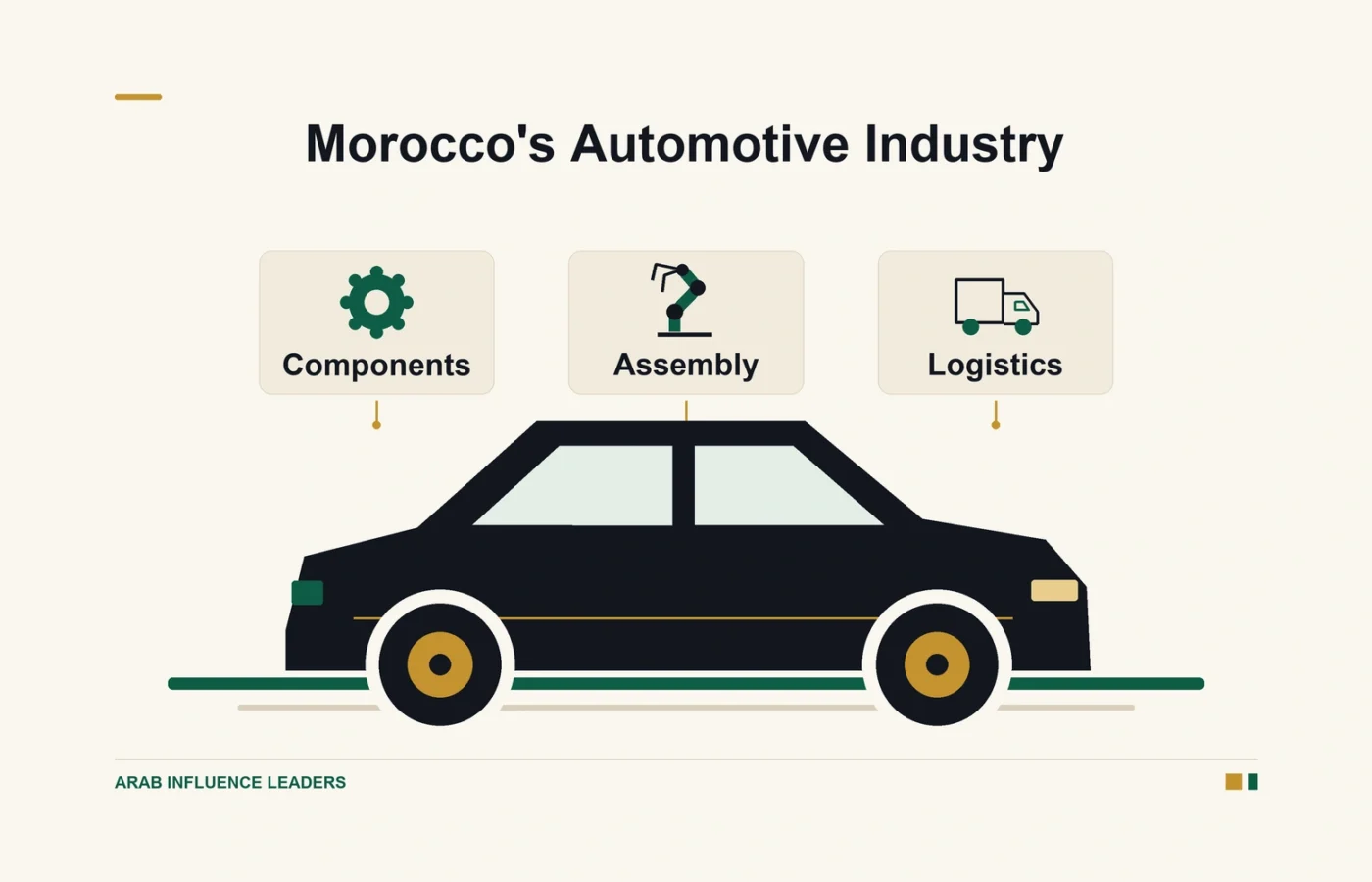
By Arab Influence Leaders. This analysis was prepared with AI assistance and draws on the sources below. Original illustration by Arab Influence Leaders.
Morocco’s automotive industry is often described through vehicle totals or the value of new investments. A more revealing question is how much of the work surrounding a vehicle can be performed locally, and who develops the knowledge to improve it. Electric mobility makes that question more important: assembly connects with components, engineering, testing and services. Understanding the transition requires separating recorded production from future capacity and investment targets.
Start with actual production
In an overview published on 29 June 2026, Renault Group reported producing more than 394,000 vehicles in Morocco during 2025. That is the group’s output, rather than the country’s total. The company also described 82% of production from Tangier and Casablanca as being exported to 63 destinations, alongside an interconnected network of factories, suppliers and port infrastructure.
For readers, the distinction between capacity and output matters. Annual capacity describes what a facility is designed to accommodate; production describes vehicles actually made during a specified period. Serving multiple export markets also raises questions about consistent specifications and delivery schedules. A large headline number becomes more useful when its scope, reporting period and relationship to other measures are clear.
Look beyond the final assembly line
A simplified automotive value chain runs from materials and components through manufacturing, testing, transport and product support. At each stage, different questions apply: what is purchased locally, what is imported, who designs the process and who can resolve a defect? These questions offer a way to investigate industrial depth without treating every locally assembled vehicle as entirely locally produced.
A prospective supplier can begin by documenting a specific capability. Which component can it make reliably? How does it demonstrate consistent quality? Can a production batch be traced to its materials? These are proposed assessment questions, not universal qualification rules. A sustained supply relationship depends on the requirements of the particular customer, including its specifications, approval process and delivery expectations.
Local integration figures also need definitions. A percentage may concern one factory, a company’s purchases or a wider sector, and may include different services. Measures with different boundaries should not be treated as directly comparable.
Kenitra shows several routes into electric mobility
In a release dated 18 July 2025, Stellantis described the inauguration of its Kenitra plant expansion on 16 July. The announcement covered small electric mobility, charging equipment and powertrain-related projects. It also included a target for purchases from local suppliers to exceed €6 billion by 2030. That figure is an announced ambition, not a completed purchasing result.
This range of activities broadens the industrial discussion beyond a single vehicle model. A supplier might investigate charging equipment, components for smaller vehicles, or testing and maintenance capabilities. These are areas for analysis, not a list of available contracts. A commercial assessment still needs evidence of a particular customer’s demand and the ability to meet it.
Separate a battery agreement from an operating plant
On 6 June 2024, Morocco’s Head of Government announced an investment agreement with Gotion High-Tech for an electric-vehicle battery project. The first phase was described as having planned capacity of 20 gigawatt-hours and announced investment of MAD 12.8 billion. These figures describe the agreement at that date; they do not establish subsequent commercial output.
A useful project tracker distinguishes the agreement, site preparation, equipment installation, trial operation and commercial production. It should also distinguish cells, modules and battery-pack assembly. The broad label “battery project” does not explain every process that a facility will contain. Progress needs to be attached to a defined milestone and a dated source.
Measure deeper capability through skills and quality
Beyond counting factories, this analysis proposes tracking suppliers’ ability to deliver conforming batches, resolve defects and maintain industrial customer relationships. Training projects can address component traceability, rejection analysis and reading product specifications. A classroom project, however, should not be presented as industrial certification.
For readers following Arab economies, Morocco’s wider significance lies in the relationship between major projects and the businesses around them. Local value becomes deeper when firms and workers can perform more complex tasks and demonstrate their quality. Assessing that progress requires evidence with clear dates and boundaries, rather than combining announced capacities and future targets into one impressive total.