
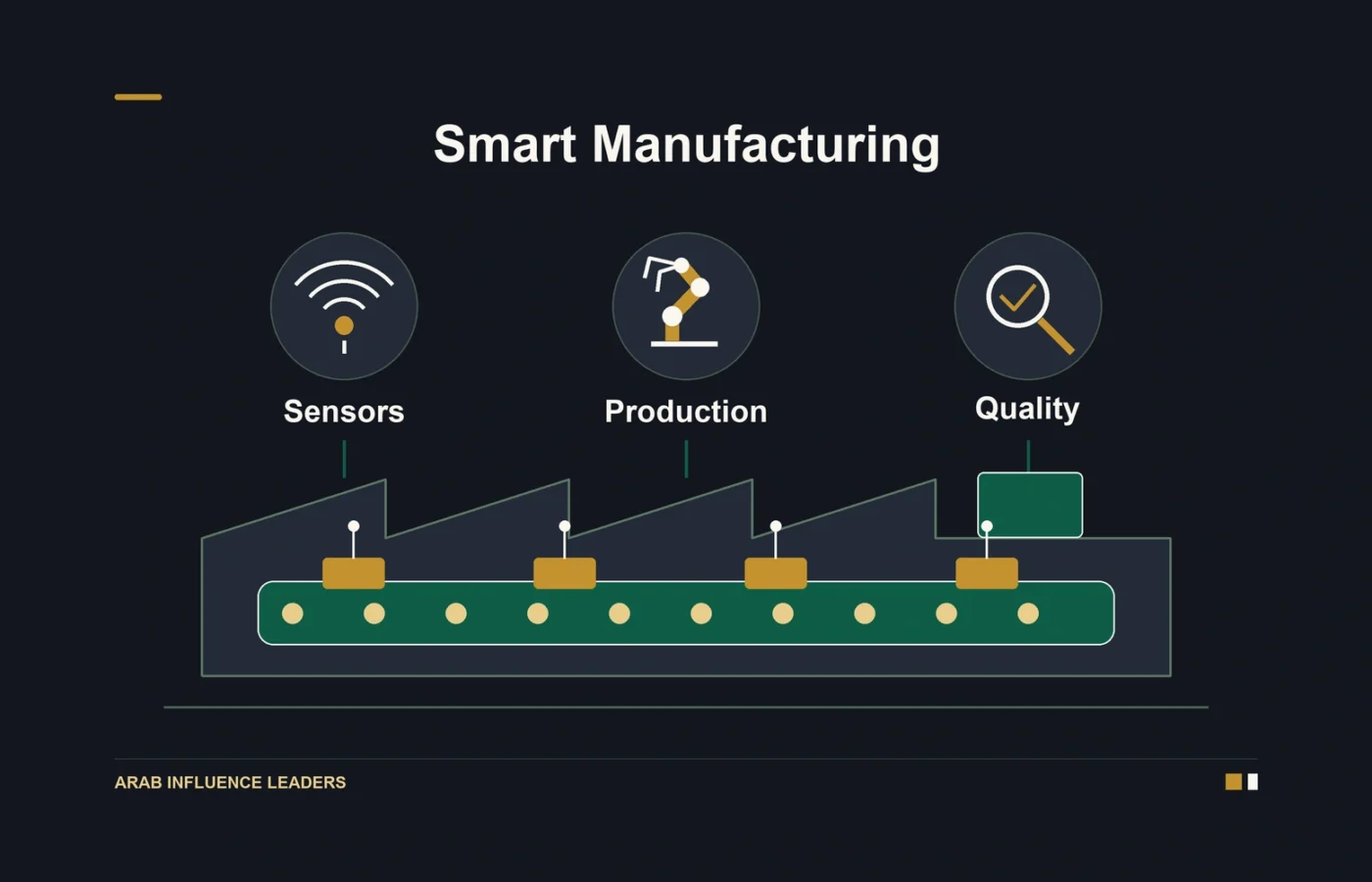
By Arab Influence Leaders. This analysis was prepared with AI assistance and draws on the sources below. Original illustration by Arab Influence Leaders.
When an industrial order is late, a factory manager needs to know where the delay occurred. Did materials arrive late, did the line stop, or was the batch rejected during inspection? This hypothetical example provides a practical starting point for smart manufacturing. Value comes from connecting an event on the factory floor with a decision someone can make. Arab manufacturers can build that connection gradually, choosing approaches suited to their equipment, products and workforce.
Assess digital maturity before choosing a system
On 15 February 2023, the UAE Ministry of Industry and Advanced Technology and Abu Dhabi Department of Economic Development announced the Industrial Technology Transformation Index, or ITTI. The launch described 20 dimensions across the value chain, including four associated with sustainability, to assess industrial maturity and guide transformation. That is the structure of an assessment tool, not evidence of identical performance gains at every participating factory.
The same diagnostic logic can inform an internal review. Where is information reliable? Where is it repeatedly entered by hand? Who uses the resulting report? One factory may need consistent material names; another may need laboratory results connected to production batches. Starting with an operational problem gives a technology project a clearer purpose.
Give each batch a traceable record
A practical first step is to assign each batch a stable identifier that follows it from receipt to delivery. The record can connect the material source, production order, operating time and inspection result. The aim is not to collect every possible reading immediately. It is to establish a small, understandable record that workers and supervisors can use consistently.
Saudi Arabia’s Ministry of Industry and Mineral Resources describes basic digitization within its Factories of the Future initiative as groundwork for more advanced digitalization and automation. Examples include resource and production planning, production-line data, material handling and sensors. This outlines possible starting points; it does not establish that every factory needs every solution or qualifies for support.
- Choose one product family and agree what defines a batch and changes its status.
- Connect the record to a clear inspection point and assign responsibility for correcting errors.
- Follow an order from start to finish and ask whether its record explains a delay or defect well enough to support action.
Connect a sensor reading to an action
Before adding a sensor, specify the decision its reading should support. Understanding downtime may first require consistent records of its duration and cause. Measuring resource use requires a defined measurement point, unit and product boundary. These are proposed design steps, rather than reported results from a particular Arab factory.
Every maintenance alert also needs a response: who reviews it, when should equipment be inspected, and how is the finding recorded? In quality control, linking inspection results to batches and operating conditions can help specialists investigate recurring problems. Accumulating alerts provides little clarity if no one knows which signals require intervention or who can authorize it.
Use shared definitions to understand suppliers
The Saudi ministry’s Local Supply Chain Development Initiative describes a database and product analysis alongside the alignment of coding, specifications and supplier qualification. These are elements of the initiative’s stated scope, not proof that a particular product has already been localized.
The practical implication is that supplier comparisons need a common definition of the component. If purchasing and warehouse teams use different names, performance records may become difficult to reconcile. A structured supplier file can connect deliveries, inspection results, rejection reasons and corrective responses, rather than reducing the comparison to price or distance.
A specific defect can also guide a more productive conversation. Is the issue packaging, component dimensions or inspection documentation? This is a proposed approach to developing a supplier relationship, not an assumption that a local business can automatically replace every imported component.
Measure progress and retain operators’ knowledge
Define the products, line and period used to evaluate a project. Useful measures may include the time needed to retrieve a batch record, completeness of data and time spent resolving rejection causes. If scrap rates are compared, explain the calculation and any change in product mix or operating conditions. Counting screens and sensors does not measure the effect of digitalization.
Scaling the project also requires instructions operators understand: how to record information, what each status means and how to work during a system outage. Their feedback can identify problems before a process is standardized. When a manufacturer can trace its product, investigate defects and discuss supplier performance using consistent evidence, it has a stronger foundation for more advanced manufacturing projects.