
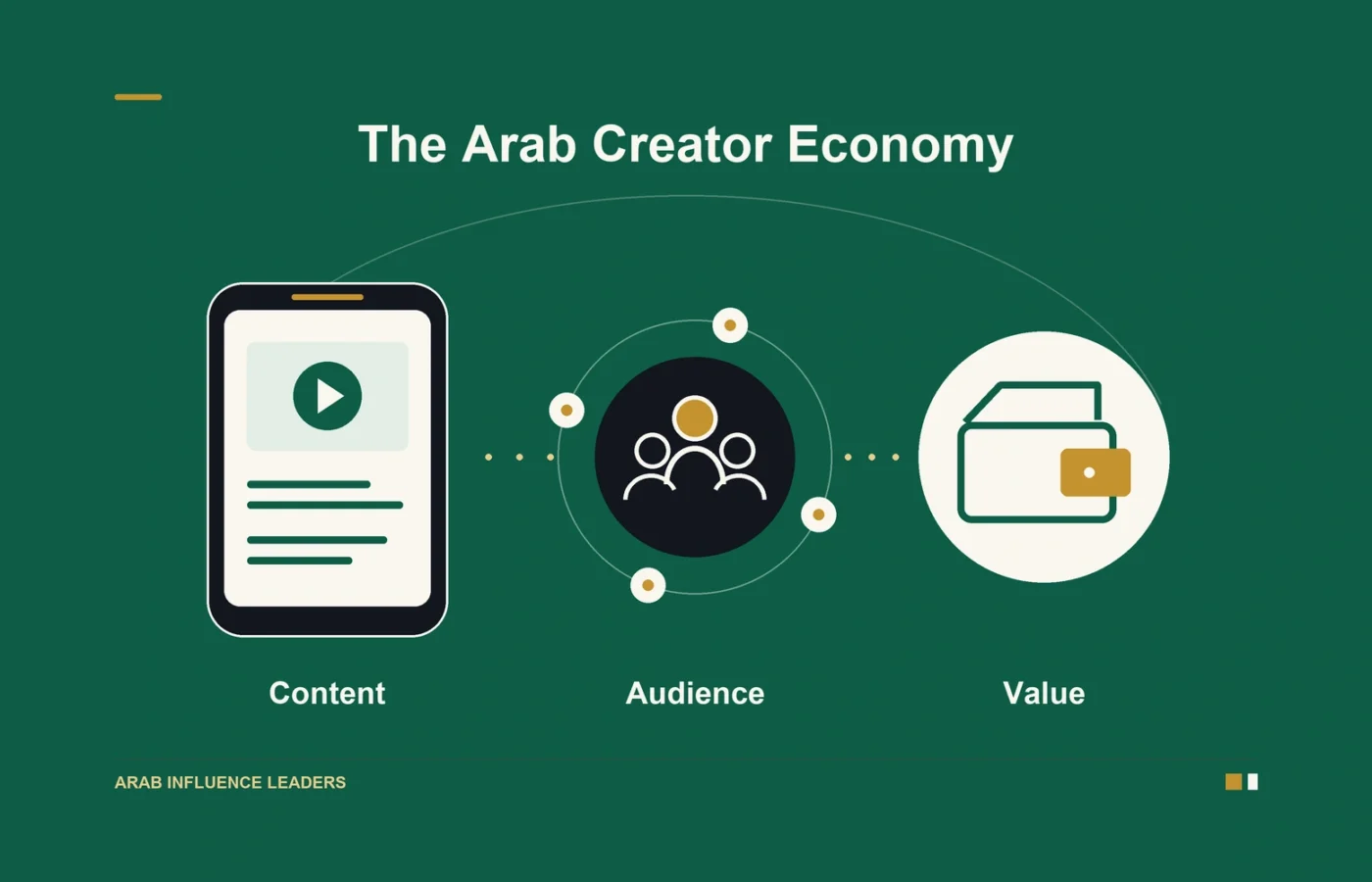
By Arab Influence Leaders. This analysis was prepared with AI assistance and draws on the sources below. Original illustration by Arab Influence Leaders.
Discussions about the Arab creator economy often begin with follower counts. Building a business requires a closer look at what people return for, who pays for it and what remains after production costs. This analysis connects revenue, ownership and audience trust, drawing on documented examples without assuming that one model suits every Arab market or creative discipline.
Define the product behind the audience
On 12 January 2025, Emirates News Agency reported the opening of Creators HQ in Dubai to support creators and their businesses. Its launch announcement included an ambition to attract 10,000 influencers in the following period. That was a target, rather than a result achieved at the opening. The development illustrates institutional interest in helping creative activity become organised work.
For an individual creator, that transition starts with defining the product: an explanatory series, a podcast, educational material or specialist coverage. A clear definition makes it easier to estimate the time, people and rights required to produce it consistently. Moving between unrelated subjects to follow every surge of attention can make the audience promise harder to understand and the work harder to price.
Match revenue to a clear promise
YouTube’s monetisation guidance describes options including advertising revenue, channel memberships, a share of YouTube Premium subscriptions and brand partnerships. Each feature has its own eligibility requirements. These options should therefore be assessed for the particular channel and market.
A useful business distinction is between people who give their attention to free content, subscribers who pay for a defined service and organisations that fund production or license material. Each relationship brings different obligations. Membership requires continuing value; sponsorship needs understandable disclosure; licensing requires an agreed scope of use. Several revenue sources may reduce reliance on one customer, but launching too many offers can also stretch a small production team.
Treat trust as part of the product
A UNESCO survey published on 26 November 2024 covered 500 digital content creators and influencers in 45 countries. It found that 62% did not conduct rigorous, systematic fact-checking before sharing information. This was an international sample, not a separate measurement of Arab creators. It nevertheless provides a reason to consider verification when designing a production process.
That discipline becomes particularly useful when a publication or account combines explanation with commercial content. Readers can make a more informed judgement when they know where information came from, when it was produced and whether a sponsor influenced the choice of subject. A clear corrections process also provides a way to address mistakes openly.
Prominent sponsorship disclosure helps audiences understand the relationship behind a message. That editorial practice should be considered alongside the applicable local requirements, which need to be checked in each jurisdiction.
Keep control of rights and the archive
A content library can remain useful over time when its files are organised and its rights are understood. Before repackaging a recording as a course, digital book or special edition, establish who owns it, whether photographs can be reused and whether participants agreed to the intended formats. Clear agreements give the people involved a shared starting point, with specialist advice where needed.
A website or organised archive also gives readers a route back to material beyond the daily flow of posts. Full transcripts, sources, updates and links to related episodes can make that archive easier to use. Building a direct relationship with readers takes its own care: an email subscription should have a clear purpose, informed consent and an accessible way to leave.
Measure the business beyond views
A practical review can bring together production time and cost, publishing consistency, returning audience members, renewed contracts and income after expenses. Separating the cost of one episode from general overheads helps a team understand whether it can repeat the work. A widely viewed post does not, by itself, establish that its audience will return or pay for a service.
A small, time-limited offer can provide a useful test before expansion. Did people understand its value? Could the team deliver it reliably? Did the commercial arrangement respect the stated editorial boundaries? These questions keep growth connected to the work a creator can sustain and the relationship an audience has chosen to support.