
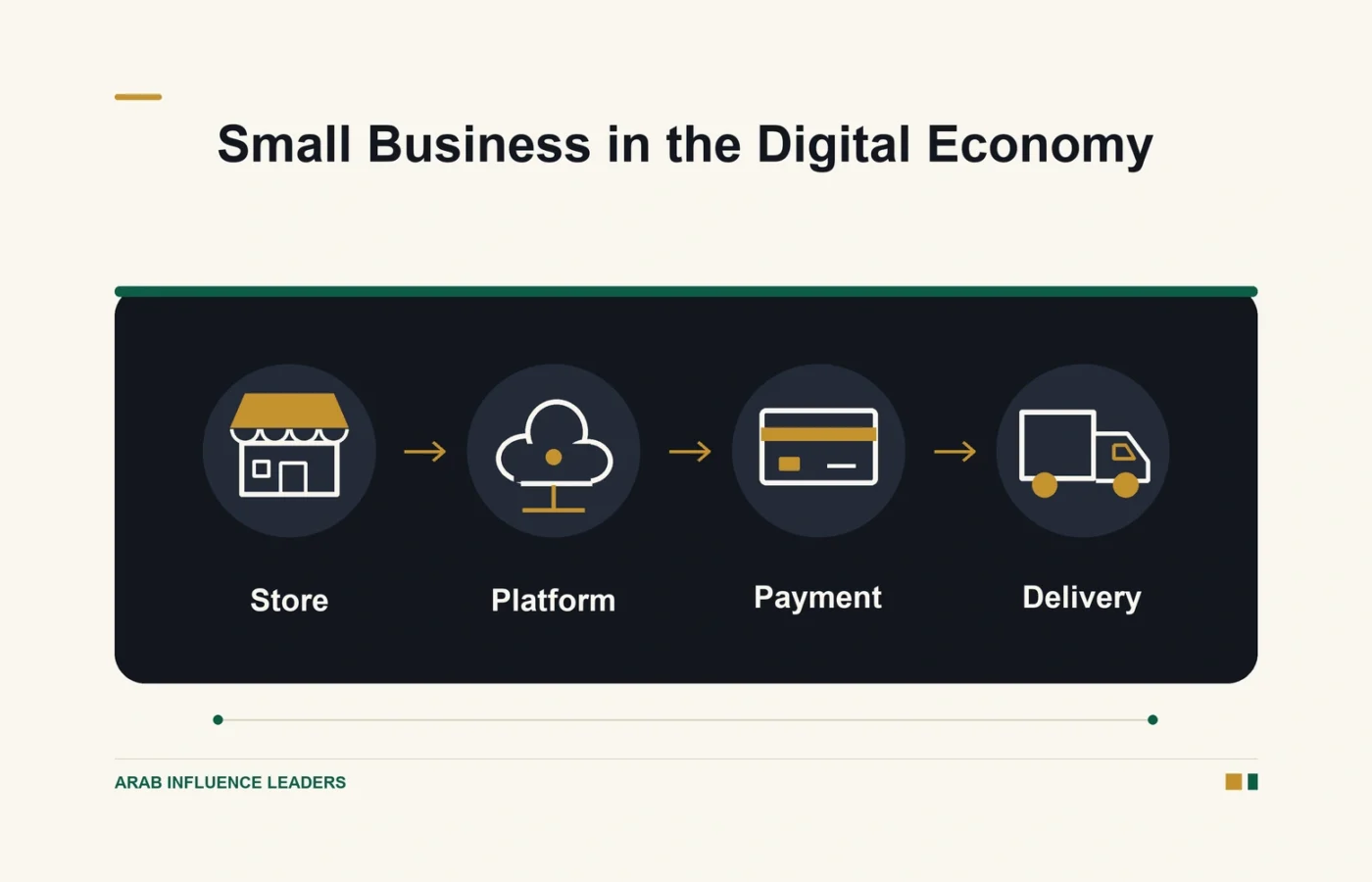
By Arab Influence Leaders. This analysis was prepared with AI assistance and draws on the sources below. Original illustration by Arab Influence Leaders.
A small business may receive orders through a website or messaging app, then turn to paper records to check stock and track payment. The customer-facing step is digital, but the work behind it remains disconnected. A practical approach to digitalization for Arab SMEs begins by linking those steps and examining the effect on service, cost, and time. Buying software alone does not establish that a business has improved.
Examine how digital activity supports transactions
The World Bank’s The Upside of Digital for the Middle East and North Africa, published on 16 March 2022, described a gap between widespread social-media use and limited adoption of some economic applications, including digital payments. It is a historical regional assessment covering Arab and non-Arab countries, not a description of every Arab market in 2026.
The Bank’s Digital Progress and Trends Report 2023, launched in March 2024, also describes uneven business adoption, with small firms in lower-income countries lagging behind. This global observation is a reason to examine a company’s actual connectivity, staffing, and training needs. It does not establish that all Arab businesses share the same starting point.
The practical question is whether a digital tool helps complete a transaction. Attracting attention is valuable, but the business also needs to fulfill what the customer orders.
Map the order before choosing a tool
Follow one order from arrival to delivery. Where is it recorded? Who confirms that the product is available? How does the address reach the delivery team? Who handles a return? Repeatedly entering the same information suggests a place to investigate. If shortages are causing delays, more advertising alone will not resolve the underlying problem.
In a hypothetical local shop, a shared product list and consistent order numbers might be a more useful first step than a new app. Each order could carry its status, delivery date, and payment method, with responsibility assigned for the next action. This is an illustrative process, not a claim about results achieved by an existing shop.
Make payments part of the operating process
The Global Findex Database 2025 uses World Bank survey data collected in 2024 on adults’ use of financial services. It also provides comparable information on digital connectivity and safety. These are data about individuals, not a survey of business digitalization. Country-level findings can help describe the customer environment, while a company still needs to test the buying experience with its own audience.
Within the business, staff should understand when an order counts as paid, how payments are matched to orders, and how a refund is processed. State the price, delivery charge, and order status clearly. A technically available payment option still needs an understandable customer journey and a workable process for resolving errors without passing sensitive information through informal conversations.
Measure changes in the work
Useful starting measures might include the time from order confirmation to delivery, cancellations, inventory-record accuracy, and the number of contacts needed to resolve a customer problem. Select measures relevant to the business and record a baseline before changing the process. Faster fulfillment deserves closer examination if errors or returns rise at the same time.
Separate the possible effect of the new tool from seasonal demand and promotions. Higher sales during a discount campaign do not, by themselves, prove that a new system is working. Compare reasonably similar periods, track several measures, and note other changes. Structured observations from staff can also explain problems that the numbers alone do not reveal.
Roll out at a pace the team can manage
Choose one recurring process and a specific problem, then assign someone to oversee it. Clean the essential records, train the people using them, and test a complete order, including cancellation or return. Review the results before expanding. These are proposed implementation steps for the business, not an official program issued by the organizations cited.
Decide who can view and change customer information, maintain a usable backup, and collect only the information needed for the work. When selecting a provider, consider data export, support, and local operating requirements. The test of progress is whether the team can deliver a clearer, more consistent service and explain the improvement with evidence.