
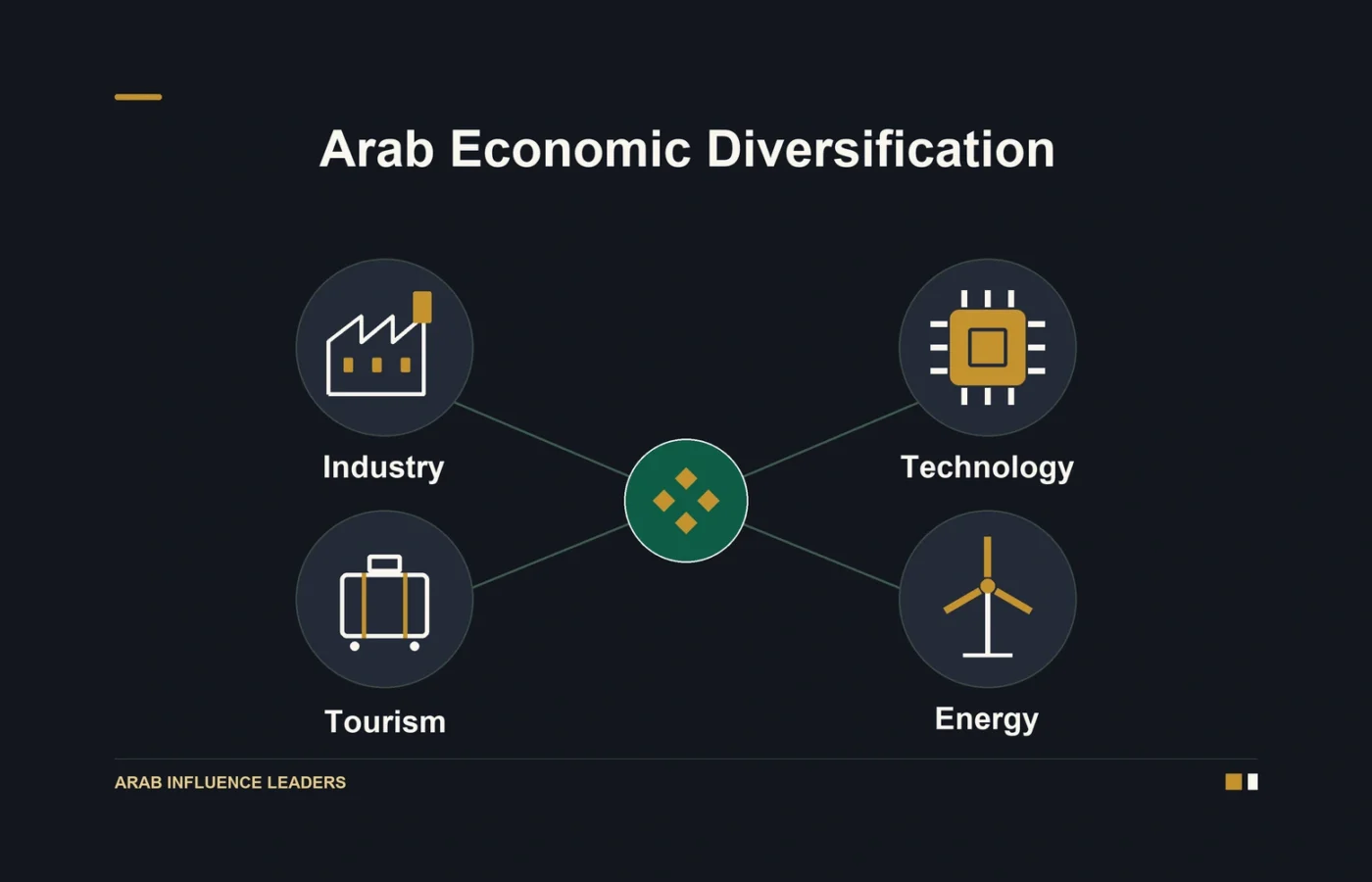
By Arab Influence Leaders. This analysis was prepared with AI assistance and draws on the sources below. Original illustration by Arab Influence Leaders.
Economic diversification can sound like a competition between growth rates. A more useful question is what the expanding activity leaves behind: skills, knowledge, capable suppliers, and lasting demand. A major project’s opening is easy to identify. The development of smaller businesses around it takes longer to assess. Reading that transformation requires several measures and an understanding that Arab countries face different economic circumstances.
Start with what the figures measure
In its release dated 9 March 2026, Saudi Arabia’s General Authority for Statistics reported real GDP growth of 4.5% in 2025, with non-oil activities growing by 4.9%. The first figure describes the whole economy; the second describes activities within it. Real GDP adjusts for price changes, helping distinguish changes in the volume of activity from increases in monetary value alone.
A separate UAE Ministry of Economy announcement on 15 June 2025 reported 4% real GDP growth for 2024. Non-oil activities grew by 5% and accounted for 75.5% of real GDP. These are 2024 results, not a 2026 total. Comparing their growth rate directly with Saudi figures for a different year would not establish an overall regional leader. The examples explain indicators rather than survey every Arab economy.
Separate three dimensions of diversification
Production, exports, and government revenue can diversify at different speeds. A sector serving domestic customers may expand non-oil activity without adding substantial exports. Businesses may sell more abroad while public finances remain closely tied to one principal source of income. Each claim therefore needs an indicator that matches its scope and a clearly defined comparison period.
Growth in a sector becomes more informative when examined alongside its ability to retain customers, improve quality, and develop suppliers. Building a facility and operating it create different kinds of demand. Distinguishing those stages helps explain whether an opportunity depends on a temporary project or on a continuing activity that could serve additional customers.
Connect investment with productivity
In an IMF speech on 11 February 2025, productivity, skills, innovation, and regional integration featured among priorities for economic transformation. The speech concerned the Gulf Cooperation Council, not the entire Arab world. Its relevance here is the attention it gives to the conditions that make investment productive, beyond the size of an announced commitment.
Consider a hypothetical factory that buys faster equipment. Its value may remain limited if materials arrive late or the same defect repeatedly interrupts production. Better scheduling and staff training could help the factory use the equipment more effectively. This illustrates a question about operations; it is not a measured result from a particular business.
That distinction matters when following investment news. Spending can establish capacity, while the resulting performance still depends on how resources are used. Ask what changed in the operation and whether the improvement can be maintained.
Look beyond the headline project
A local business can examine the activities surrounding a major development: maintenance, transport, software, or quality inspection. These questions provide a way to understand a sector’s needs. They do not establish that contracts are currently available. A business considering expansion would still need to examine purchasing requirements, payment schedules, and quality expectations.
Local provision alone also says little about the depth of the economic contribution. More revealing questions concern the knowledge developed inside the supplier, its ability to serve several customers, and whether that capability can travel to another market. Dependence on one buyer can leave a business exposed even when its present sales look strong.
Read economic news with a consistent checklist
For each headline, identify the year of the data, whether the figure is real or nominal, and whether it measures production, exports, or announced investment. Check whether it refers to one country or a group. Follow the same indicator over time rather than combining unlike numbers into a single growth story. A planned capacity or proposed financing package is different from completed output.
This approach treats Arab economic diversification as a set of changes across countries and sectors. The useful test is whether an activity develops lasting productive capacity, transferable skills, and businesses able to compete. It is an analytical way to follow the transition, rather than a guaranteed growth forecast or an investment recommendation.