
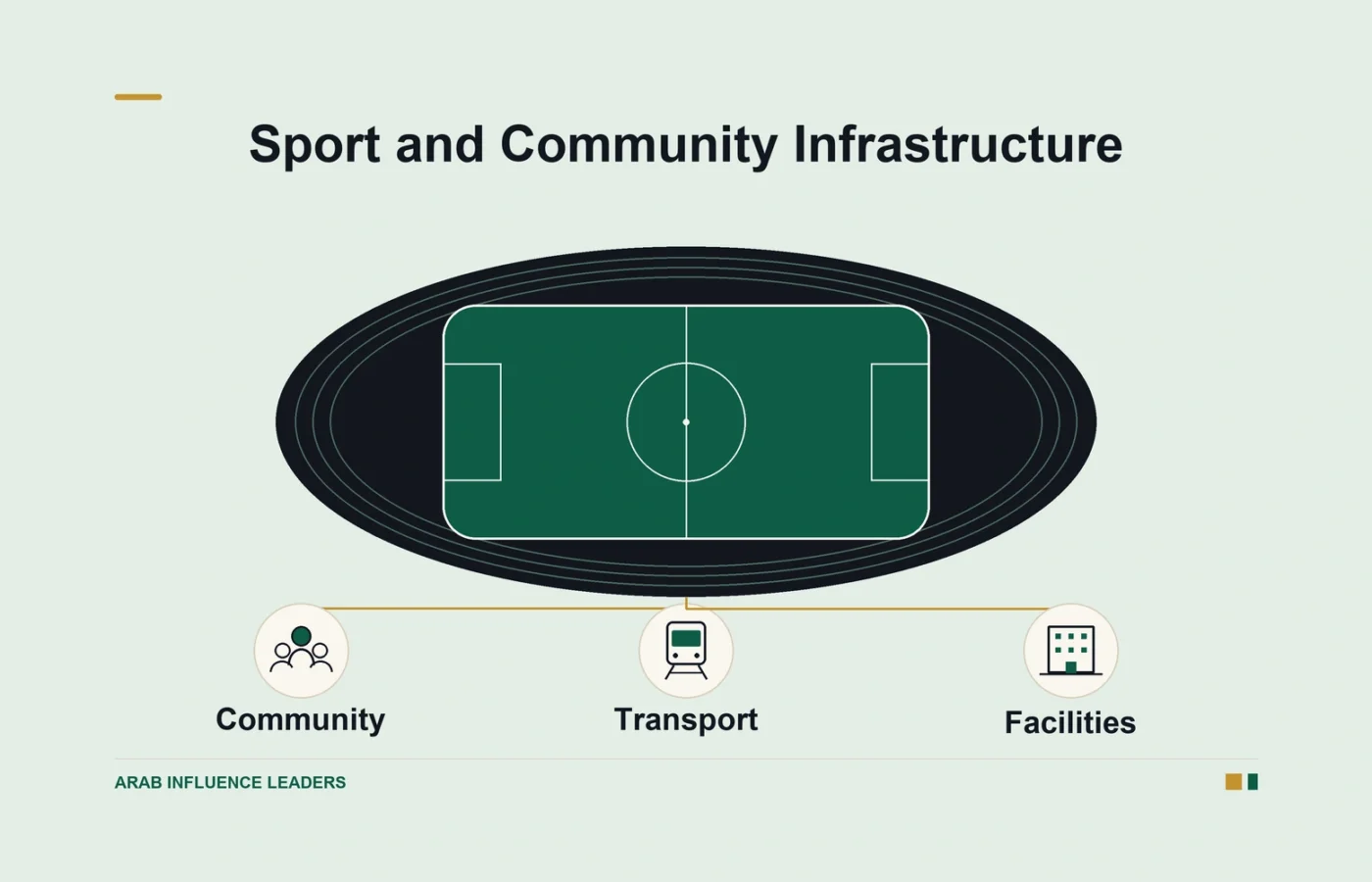
By Arab Influence Leaders. This analysis was prepared with AI assistance and draws on the sources below. Original illustration by Arab Influence Leaders.
Major tournaments draw attention to stadiums and host cities. Part of the value of Arab sports investment, however, takes shape in less visible work: a pitch near a school, a qualified coach or an activity programme that continues after the event. This analysis examines that connection through documented examples, separating the award of hosting rights, a construction commitment and a facility already in use.
Hosting begins a longer commitment
On 11 December 2024, the FIFA Congress appointed Morocco, Portugal and Spain to host the 2030 World Cup and selected Saudi Arabia for the 2034 edition. The official host announcement documents those decisions. The readiness of individual facilities, their future operating costs and their effects on residents require separate evidence and continued assessment.
Planning can begin by defining who will use a venue after a tournament. Which events could it accommodate? Who will manage bookings and maintenance? How will schools and local clubs gain access? Seating capacity alone cannot answer these questions. An existing facility or a neighbourhood pitch may suit one need, while an international competition requires different infrastructure. A useful comparison starts with purpose, users and available resources.
Distinguish the plan from the completed facility
Morocco provides a specific example. In an 8 April 2026 report on a FIFA Arena legacy workshop, FIFA described a January 2026 agreement to install 30 mini-pitches across the country. The report also recorded the inauguration of the first mini-pitch in Meknes in November 2025. These represent different stages: a documented opening and a plan for a larger network. The report did not establish that all 30 sites were complete.
A project record can make those stages easier to follow. It could distinguish the announcement, stated funding, construction, inauguration and the start of public use, with a dated source for each update. That approach gives readers a way to assess progress and leaves room for an explanation when schedules or the intended service change.
Include coaches and schools in the investment
On 20 February 2025, FIFA reported that its Football for Schools launch in Morocco included training for 52 physical education teachers and an anti-discrimination module. The announcement described eventual involvement by 3,000 schools. It documents the training activity; the school figure was the programme’s intended reach at that point.
The example suggests a wider view of infrastructure that includes the knowledge of the people running activities. Children need sessions suited to their stage of development, clear instructions and supervision. A school can connect activity to a regular routine when time, equipment and coordination are available. Equipment distribution alone does not explain how those resources will support repeated participation.
Build a service around the community
In a statement published on 26 November 2024, Generation Amazing Foundation reported that its partnership with the West Asian Football Federation Foundation included the launch of a community club in Aqaba on 23 November, when their memorandum of understanding was signed. The statement described the development of two community clubs, in Aqaba and Baqaa. It records an announced activity and partnership, rather than independently demonstrating long-term social outcomes.
For programme designers, this raises practical questions. Can young people attend regularly? Do families know the schedule and who is responsible? Are there suitable arrangements for girls and participants with disabilities? These are suggested discussion points for users and organisers, not findings about the named facilities. A way to collect feedback and address problems can help the service respond to participants’ actual experience.
Measure the legacy through everyday use
A useful assessment could track opening days, school and community hours, returning participants, operating costs and continuity among coaches. Depending on the project’s purpose, it might also examine accessibility or the regularity of local competitions. Each measure needs a clear definition and reporting period. Repeated attendances should not be presented as the same number of distinct people.
Comparing planned use with actual use also helps identify questions for investigation. Gaps might involve scheduling, transport, maintenance or awareness, but their causes need local evidence. Claims of social improvement similarly require an appropriate assessment, rather than an inference from attendance at an opening event.
This approach gives the daily work of schools, clubs and facility teams a place in the discussion of sporting legacy. Resources, access and continued participation become things to examine over time, while future benefits remain propositions to test.