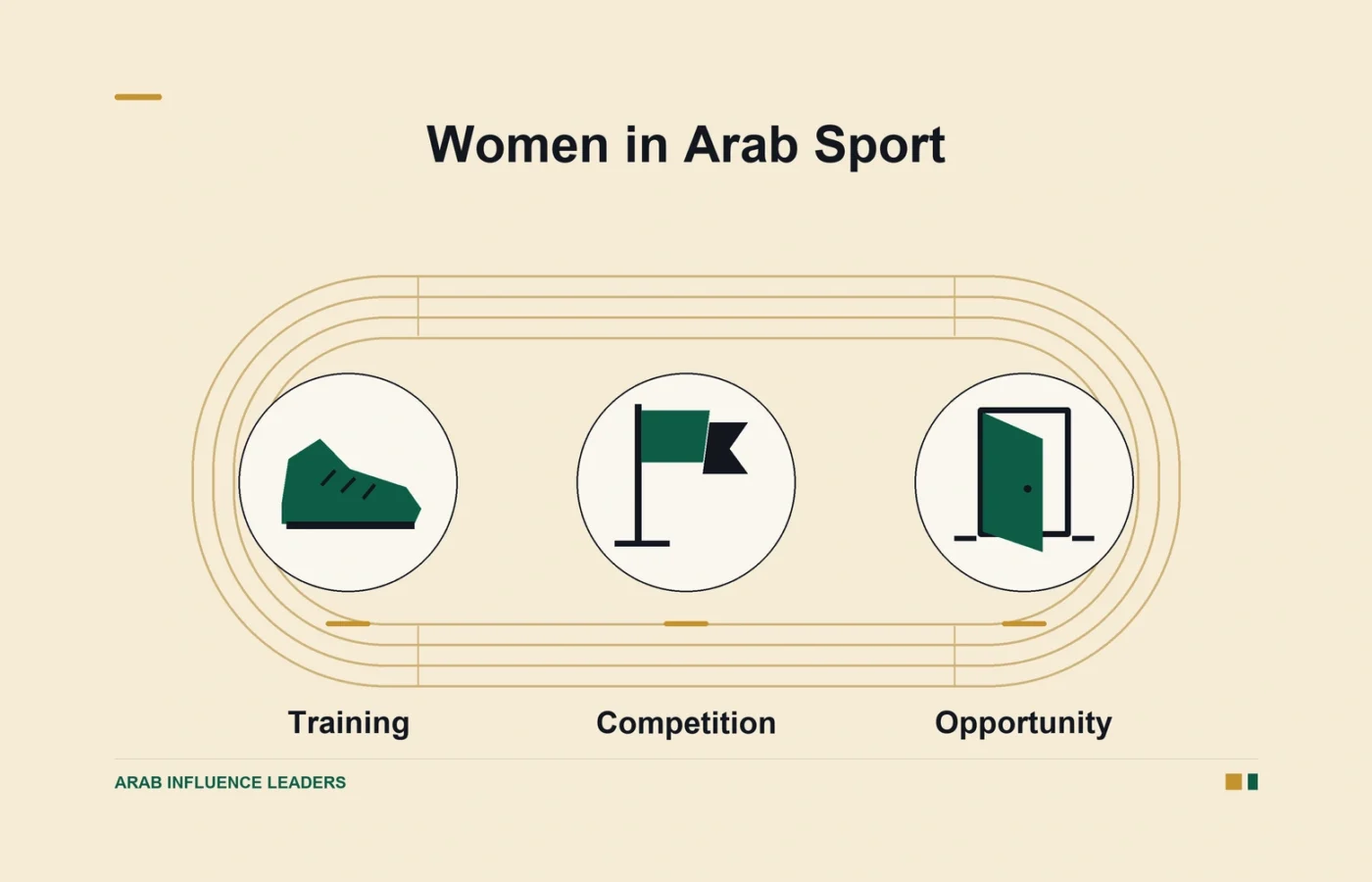
By Arab Influence Leaders. This analysis was prepared with AI assistance and draws on the sources below. Original illustration by Arab Influence Leaders.
A medal captures a moment with a name, a competition and a date. A sporting career develops through training, education, competition and everyday support. Bringing these perspectives together helps explain both an achievement and the opportunities that might allow others to pursue their own ambitions. This analysis draws on documented examples from Morocco, Algeria and Tunisia, while recognising that athletes’ circumstances differ across sports and countries.
Nawal El Moutawakel’s historic gold
On 8 August 1984, Morocco’s Nawal El Moutawakel won the women’s 400m hurdles at the Los Angeles Olympics, becoming the first Arab woman to win Olympic gold. A World Athletics account published in April 2021 documents the achievement. Its historical importance begins with that specific sporting result and the competition in which she earned it.
The story can also prompt practical questions: how does a girl find a club, gain access to suitable coaching and progress into competition? Those questions connect a visible example to the opportunities available today. They do not establish that one medal caused a wider change in participation. Understanding that connection requires local information and attention to the programmes people can actually join.
Follow careers across competitions
The international gymnastics federation’s record for Kaylia Nemour documents her uneven bars gold for Algeria at the Paris 2024 Olympics. It also lists her first place on uneven bars and second place on balance beam at the 2025 Artistic Gymnastics World Championships in Jakarta. These dated results show her career across different competitions.
Following more than one event provides a fuller sporting account. Coverage needs to distinguish the Olympics, World Championships and World Cup events, as well as an apparatus result from an all-around placing. Explaining those differences helps readers understand the performance being discussed. Attention to skill, preparation and progression can add substance to an athlete’s story beyond a general description of inspiration.
A route from athlete to coach
On 29 March 2024, United World Wrestling documented the participation of Tunisia’s Marwa Amri, a Rio 2016 bronze medallist, in the WISH coaching development programme. Its report published before the Paris Olympics describes the programme’s connection to Olympic Solidarity and its focus on leadership and coaching. Amri’s participation offers a specific Arab example of development beyond competing as an athlete.
The Olympic Solidarity and NOC Services Annual Report 2024 describes WISH as a 21-month programme combining online learning, mentoring and a residential component. It addresses leadership, sport-specific skills and professional networks. That describes the support offered within the programme, without establishing that an equivalent opportunity is available to every coach in the region.
A useful lesson for clubs and federations is to connect development with a practical role: experienced supervision, regular feedback and opportunities to take responsibility. A certificate alone does not show whether a participant will have a team to coach or time to apply what she has learned. Evaluating the pathway therefore extends beyond the end of the course.
Make the club pathway clear
For participation programmes, we suggest examining the athlete’s experience from registration onwards. Clear age groups, training schedules, costs and routes into competition help families and athletes make realistic decisions. A named contact who can explain the activity and respond to difficulties also makes the opportunity easier to navigate.
Programme planning can address safeguarding, privacy, suitable facilities, a clear complaints process and coordination with education. These are proposed service standards, not claims about shortcomings at a particular club. The details will vary with age, sport and competition level. Listening to participants should therefore be part of both programme design and review.
Give progress appropriate measures
A sports organisation could track registrations, retention between seasons, reasons for leaving, the regularity of competitions and the number of women coaches taking on active roles. These are suggested indicators, rather than regional statistics. Separating them by age group and sport helps prevent the success of one team from standing in for an entire system.
Media coverage can likewise make room for technical work and the contributions of clubs, officials and coaches, with clear sources for results. Interviews can explore skill development, professional challenges and decisions that shaped a career. Connecting accurate sporting history with the opportunities available in daily life produces useful material for both a reader seeking a place to participate and an organiser assessing a programme.